
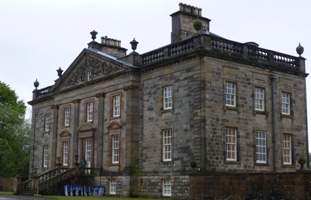
The present-day Auchinleck House was built ca. 1758-60 by Alexander Boswell, replacing what became known as the Auchinleck Old Place, which was built in 1612. Most remains of an even older castle on the lands had already disappeared by then.
The architecture of the house itself borrows heavily from nearby Dumfries House, which was built just a few years earlier by the Earl of Dumfries. However, being of more limited means that his neighbour, Alexander (then known as Lord Auchinleck, due to his position as a judge in the Court of Sessions) opted for a smaller solution. The architect of Auchinleck House is not known, and it has been speculated that Lord Auchinleck simply told a builder to design a smaller version of Dumfries House with a more compressed main building and without any wings. Even so, Auchinleck House did contain some advanced features for its day, including some very modern plumbing, as was later discovered when the house was renovated in the late 20th century.
Auchinleck House was uninhabited and not taken care of for a few decades until in 1986 it was turned over to the Scottish Historic Buildings Trust (SHBT) by a descendant of the 18th century Boswells. The SHBT did some renovations on the building before, in 1999, Auchinleck House was sold to the Landmark Trust.
It has since been thoroughly renovated and is now open both for visiting and for staying, accommodating up to thirteen guests at a time.
Auchinleck House is located some 4 km west of the village of Auchinleck, and it is most easily accessible by car. If you're not driving yourself, you can take bus X76 from Glasgow via Kilmarnock and get off either at Auchinleck Main Street or a bit further on in the town of Cumnock. A cab (one-way) will cost you around £15-20 from Cumnock. Don't forget to bring your wellies, as the grounds can be rather muddy.
If you decide to stop by Auchinleck itself, don't forget to visit the village church, next to which is the Boswell Mausoleum, the biographer's final resting place. The pub across the road from the church is named Boswell Arms, but apart from that, it has no connection with Boswell.
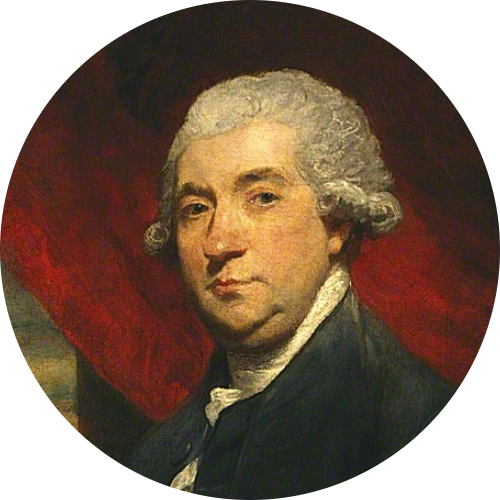
Contrary to what was thought by some of his early biographers, James Boswell was almost certainly not born at Auchinleck, which in 1740 was still in the possession of his grandfather, but in his father's house in Edinburgh. Boswell's father became the 8th Laird of Auchinleck in 1749, and Boswell himself became the 9th Laird in 1782. Boswell was enormously fond of the place and the surrounding lands, as is documented in his journal and by his surviving correspondence with overseers James Bruce and Andrew Gibb.