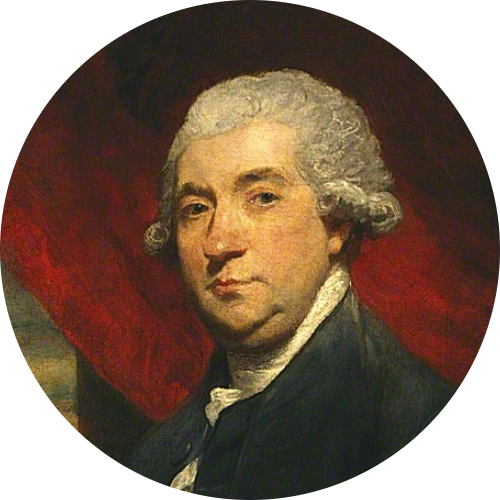

Natural son of Phillip Dormer Stanhope (d. 1773), 4th Earl of Chesterfield, and Madelina Elizabeth du Bouchet. Married (1767) to Eugenia Peters (d. 1783), with whom he had been romantically involved since the 1750s, and who had already borne him two sons, Charles (1761-1845) and Philip (1763-1801).
Stanhope held a number of minor diplomatic posts and was even a Member of Parliment for St. Germans and Liskeard until 1764. From 1764 until his death he was the British envoy at the Court of Saxony in Dresden.
Boswell had a letter to Stanhope from Alexander Burnett, and called on him in Dresden on October 8, 1764. He was not at home, but on the next day sent Boswell his compliments and offered to take him to Court at noon. Stanhope arrived at twelve “very politely, and took me in his coach. Scarcely had we gone two yards when he called out, ‘Stop!’ and catching hold of me, said, ‘You can't go to Court.’ In short the court of Saxony was in mourning, and I had not a black coat”.
On October 10, Boswell dined at Stanhope's, writing, among other things, "[h]e is little and young, but much of a gentleman. He abused the King of Prussia. He talked lightly of the Saxon Court, and said he tired sadly at Dresden. This was not quite the formed man. But I liked him the better."1
Desperate to visit the actual Court of Saxony, but with no black coat to wear, Boswell managed to convince Stanhope to introduce him as an English officer, as uniformed officers only needed to put a black crape around their sleeve to be considered to be in mourning. Consequently, on October 12, 1764, Stanhope presented Boswell, posing as an officer in Lord Loudoun's regiment, at the Court. On that same day, he dined with Stanhope, in the company of "Mr. Mackenzie, a relation of the Seaforth family" and "the Elector's Master of Horse" (who doubted the authenticity of Boswell's uniform). In the end, Boswell wrote "I really love Stanhope. He and I were might well together. We agreed to renew our acquaintance in London". Stanhope stayed abroad for most of the rest of his life, and died in 1768, then only in his mid-30s.
- 1The editors of Boswell on the Grand Tour I note, that "Boswell must mean that his conduct was "young", for Stanhope was his elder by eight years".
Philip Stanhope's main claim to fame is the letters sent to him by his father, the 4th Earl of Chesterfield, over a period of about 20 years. They were published in the 1770s by his widow Eugenia Stanhope, titled Letters to His Son, and have been reprinted numerous times since then. Some of the letters are even included in The Letters of Phillip Dormer Stanhope, 4th Earl of Chesterfield, vol 3. They are available in various editions via AbeBooks.