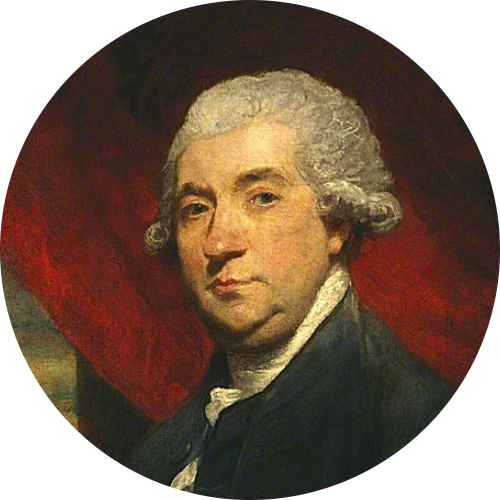
William Scott was an English judge, jurist and Member of Parliament.
William Scott's father (also named William Scott) was a tradesman working for a coal fitter's business. The young Scott was educated at Newcastle Royal Grammar School, before going to Corpus Christi College, Oxford University, where he later (1773-1785) became the Camden Professor of Ancient History. Around 1780 he graduated as Doctor of Civil Law, and he soon embarked on a distinguished legal career, eventually becoming, in 1798, judge of the High Court of Admiralty.
He unsuccessfully tried getting elected for parliament for Oxford University in 1780, but had more luck some years later, when in 1784 he was elected M.P. on a so-called double return for the constituency of Downton, which was also the reason why Boswell referred to him as "Mr. Scott of University College, Oxford (now Dr. Scott of the Commons) in his Journal of a Tour to the Hebrides, published in 1785. He was, however, unseated that same year on a petition.
He did not again seek election until 1790 when he was successfully elected Member of Parliament for Downton. He sat for this constituency until 1801, when he was finally elected for Oxford University as "a single instance of a professional man representing the university".
Scott was married twice. In 1781 he married Anna Maria (d. 1809), daughter of John Bagnall of Erleigh Court, with whom he had four children, only one of whom, their daughter Marianne, survived her father. In 1813 he married Louisa-Catherine, the widow of John, the late Marquess of Sligo.
William Scott's younger brother, John (1751-1838) also became a politician, who rose to serve as Lord Chancellor of Britain for almost three decades (1801-1806, 1807-1827)