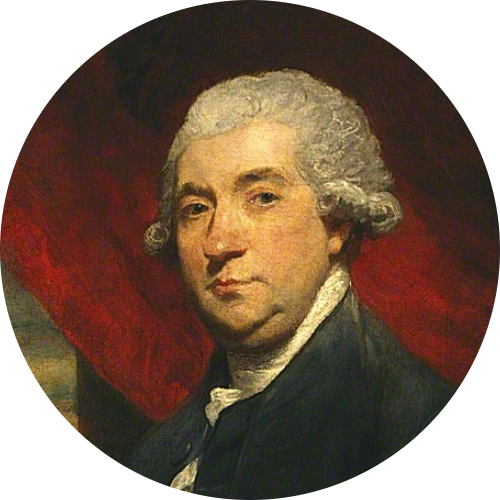
Son of Sir William Forbes (d. 1743), 5th of Pitsligo, and Christian Forbes (1705-1789), daughter of John Forbes, 1st of Boyndlie. Married (1770) to Elizabeth Hay (d. 1806), daughter of Dr. James Hay of Hayston, Peeblesshire.
Sir William and Elizabeth had several children including William1 and John Hay2.
Apprentice (1754-59) to the banking firm Coutts & Co. in Edinburgh of which he later became a partner (1761). In 1773 the bank changed its name to Forbes, Hunter & Co. Grand Master of the Masonic Grand Lodge of Scotland (1776-78). Founder member of the Society of Antiquaries of Scotland (1780) and the Royal Society of Edinburgh (1783). Shortly before his death in 1806, he published his Account of the Life and Writings of his late friend, the poet and philosopher James Beattie.
At the time of Boswell's death in 1795, Forbes was one of Boswell's closest surviving friends. It has, however, been a subject for some speculation, just how the relationship between Boswell and Forbes began and developed.
In a letter to Boswell's daughter Veronica, dated June 13, 1795 (a few weeks after Boswell's death), Forbes wrote about "the memory of a friend with whom I had lived in the strictest intimacy for thirty-six years, and to whose steady and unalterable regard and attachment I shall ever look back with gratitude and affection", which would place the beginning of their friendship in 1759, and in all probability they first met when they both became members of the masonic Canongate Kilwinning No. 2 lodge in that year. However, although they saw each other occasionally under various circumstances in the following years, there is nothing in the papers of either to suggest anything more than a cordial relationship until they began corresponding and seeing each other more frequently in Edinburgh in the mid-1770s.
Forbes dined with Boswell in Utrecht on September 21, 1763, during Boswell's stay in that city. Boswell's younger brother David was at the time an apprentice in Forbes' banking firm in Edinburgh. Following Boswell's return to Scotland in 1766, Forbes made a visit to Auchinleck in October of that year, but this was arranged by David Boswell, not James.
Their relationship does not seem to have reaced a level of true intimacy until the early 1770s. After both men married - Boswell in November 1769 and Forbes in September 1770 - they began to socialize as young couples starting their families in Edinburgh. The first recorded instance of this family socializing occurred on August 8, 1772, when Forbes and his wife, Elizabeth, supped at Boswell's flat in James's Court. The Boswells returned the visit by dining at the Forbeses' home a week later. Their bond was further strengthened in the autumn of 1772 during an extended visit to Edinburgh by their mutual friend Bennet Langton and his wife, Lady Rothes, which led to several shared suppers and dinners. By early 1773, the two families were regularly entertaining each other
Boswell introduced Dr Johnson and William Scott to Forbes at breakfast on August 15, 1773. the first morning of Johnson's stay in Edinburgh, before he and Boswell set out on the tour of Scotland. Boswell mentioned this in his Journal of a Tour to the Hebrides, in which he also wrote of Forbes that he was "a man of whom too much good cannot be said; who, with distinguished abilities and application in his profession of a banker, is at once a good companion and a good Christian." Later that day, Forbes accompanied Boswell, Scott and Johnson to a sermon by Rev. Carr at the English chapel. Two days later, on August 17, Forbes came to Boswell for breakfast, bringing with him the blind poet Thomas Blacklock.
The friendship and correspondence between Boswell and Forbes reached a higher level of true intimacy during a six-month period from mid-1774 to early January 1775. On July 24, 1774, the two men shared a long tête-à-tête concerning literature, religion, and the conduct of life. During this conversation, Forbes revealed that his meticulously kept expense accounts served as "a kind of Journal of his life" . Deeply moved by his friend's moral and structural character, Boswell resolved to emulate him, noting in his own journal, "I value him highly... I am always the better of being with him".
This growing trust culminated around New Year 1775 with a unique mutual exchange. On January 1, Boswell allowed Forbes to read the highly private, unpublished manuscript of his Hebrides journal. The very next day, Forbes reciprocated by taking Boswell into his counting-house and sharing his private account books to help Boswell establish a budget and bring order to his chaotic finances. As researchers have noted, this reciprocal sharing - where Boswell revealed his life in words, and Forbes his in numbers - cemented an unbreakable bond and marked the true beginning of their intimate, personal correspondence.
In the following decades, Forbes served as Boswell’s steadfast financial and moral anchor. Although Forbes strongly opposed Boswell's ambitions to relocate to London, even co-writing a letter to Samuel Johnson in July 1784 in an attempt to dissuade him from the "wild idea", he paradoxically ended up enabling the move. In January 1785, Forbes's bank provided Boswell with crucial financial relief by converting his mounting debts into a £1,400 interest-only heritable bond.
In return for this lifelong support, Boswell eagerly integrated Forbes into his prestigious London literary circle. He introduced Forbes to luminaries like Sir Joshua Reynolds and Edmund Burke, and ensured his participation in the famous 1776 "Round Robin" letter to Dr. Johnson.3
Following Boswell's death, Forbes was appointed one of the executors of Boswell's estate as well as guardian to his children. Some years later, in 1806, Forbes wrote the following in his Account of the Life and Writings of James Beattie :
Mr. Boswell's acquaintance and mine began at a very early period of life, and an intimate correspondence continued between us ever after. It scarcely requires to be mentioned here, that he was the chosen friend of General Paoli and of Dr Johnson. The circle of his acquaintance among the learned, the witty, and indeed among men of all ranks and professions, was extremely extensive, as his talents were considerable, and his convivial powers made his company much in request. His warmth of heart towards his friends, was very great; and I have known few men who possessed a stronger sense of piety, or more fervent devotion (tinctured, no doubt, with some little share of superstition, which had probably been in some degree fostered by his habits of intimacy with Dr Johnson) perhaps not always sufficient to regulate his imagination or direct his conduct, yet still genuine, and founded both in his understanding and his heart. His "Life" of that extraordinary man, with all the faults with which it has been charged, must be allowed to be one of the most characteristic and entertatining biographical works in the English language. For Mr Boswell I entertained a sincere regard, which he returned by the strongest proof in his power to confer by leaving me the guardian of his Children. He died in London, 19th May, 1795, in the fifty-fifth year of his age.4
It is usually possible to find antiquarian copies of Forbes' auto-biographical Memoirs of a banking-house, which was written for his son and published posthumously by a descendant in 1859, and his Account of the Life and Writings of James Beattie via the AbeBooks used books search engine. While, surprisingly, there has never been written any real biography of Sir William Forbes, the publication in 2022 of The Correspondence of James Boswell and Sir William Forbes of Pitsligo has made available a lot of never before published material about him, and this is probably one of the most comprehensive and well-researched works about him, even if his own life is not the main subject of the volume.
- 1William Forbes (1773-1828) succeeded to the baronetcy following the death of his father
- 2John Hay Forbes (1776-1854) married Louisa Gordon, with whom he had several children. He was admitted advocate in 1799 and in 1825 was made Lord of Session, assuming the courtesy title of Lord Medwyn. From 1830 until 1849 he was even a Lord of Justiciary.
- 3
The "Round Robin" was a 1776 petition signed by guests at Sir Joshua Reynolds's home, urging Dr. Samuel Johnson to rewrite his Latin epitaph for Oliver Goldsmith in English. The signatures were arranged in a circle to prevent Johnson from identifying the ringleader. Acting as the group's clerk helped Forbes integrate into Boswell's London literary circle, even though Johnson, receiving it "with much good humour" (letter from Forbes to Boswell, October 19, 1787), ultimately rejected their request.
- 4An Account of the Life and Writings of James Beattie, L.L.D (1806), p. 400