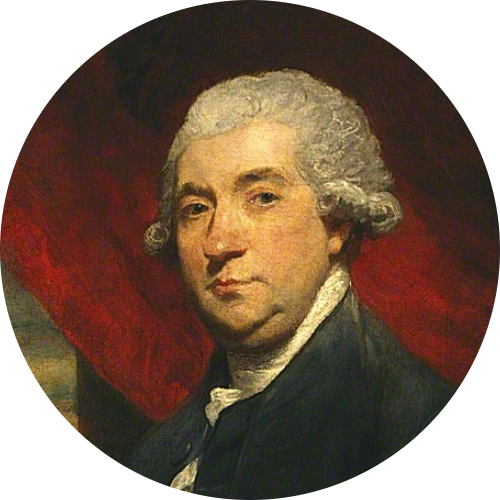
Scottish philosopher, historian, librarian and educator. Son of Joseph Hume of Ninewells (1680-1713) and Catherine Falconer (b. 1683). Brother of John Hume. A friend of Adam Smith. Member of The Poker Club.
In his own time he was most famous for having written the History of England, but is today best known as the philosopher responsible for such works as Dialogues Concerning Natural Religion, A Treatise on Human Nature and An Enquiry Concerning Human Understanding.
Boswell first met Hume in Edinburgh in July 1758, apparently with an introductory letter (or something like that) from William Temple. In a letter to Temple of July 29, 1758, Boswell wrote "Some days ago I was introduced to your friend Mr. Hume; he is a most discreet, affable man as ever I met with, and has really a great deal of learning, and a choice collection of books. He is indeed an extraordinary man, few such people are to be met with nowadays. We talk a great deal of genius, fine language, improving our style, %c., but I am afraid, solid learning is much wore out. Mr Hume, I think, is a very proper person for a young man to cultivate an acquaintance with; though he has not, perhaps, the most delicate taste, yet he has apply'd himself with great attention to the study of the ancients, and is likewise a great historian, so that you are not only entertained in his company, but may reap a great deal of usefull instruction. I own myself much obliged to you, dear Sir, for procuring me the pleasure of his acquaintance."1
On November 4, 1762, Boswell and Erskine went to see Hume in Edinburgh. The description of the ensuing conversation in the journal of his harvest jaunt that same fall, seems to be one of his first attempts to write down the details of particular conversations, as he later did when in the company of Dr. Johnson and others. The conversation hit upon literary subjects such as David Mallet, Tobias Smollet, Tristram Shandy (by Laurence Sterne), Fingal (written or collected by James Macpherson) and Lord Kames.
On February 18, 1763, Boswell sent Hume a letter, telling Hume about the trick played upon him by Andrew Erskine and George Dempster, and inquiring whether Hume would be interested in corresponding with him. On February 28 he received an answer from Hume, who complained that Boswell and Erskine had quoted a part of the private conversation they'd had with Hume on November 4, 1762, in their Critical Strictures on the New Tragedy of 'Elvira', written by Mr. David Malloch (see also David Mallet). Boswell replied on March 1, writing a humorous and slightly apologetic letter. Hume apparently did not reply. Hume's letter and Boswell's reply can be found in Boswell's London Journal.
Hume doesn't appear to have been too angry with the mischiefs and in a letter of 12/1-1766 from Hume to the Countess de Bouflers, he writes about Boswell accompanying Jean-Jacques Rosseau's mistress, Therése La Vasseur, to London: "I learn that Mademoiselle sets out first in company with a friend of mine, a young gentleman very good-humoured, very agreeable, and very mad". (Boswelliana, p. 50)
Boswell also mentions (a few times throughout February 1763) reading Hume's History of England, "which enlarged [his] views".
Boswell appears to have met with David Hume fairly frequently in the years after his return from Europe. Despite Dr Johnson being an ardent opponent of Hume and his theories, Boswell himself was ever on friendly terms with Hume and wrote the following in his Journal of a Tour to the Hebrides:
I always lived on good terms with Mr. Hume, though I have frankly told him I was not clear that it was right in me to keep company with him. "But", said I, "how much better are you than your books!" He was cheerful, obliging, and instructive; he was charitable to the poor; and many an agreeable hour have I passed with him.
In 1776 Boswell got what in modern times has been termed the journalistic scoop of the 18th century: On July 7, he visited David Hume and got a last interview with the dying philosopher. Boswell was curious as to whether Hume could keep up his religious scepticism and atheism even at death's door. It turned out that Hume was just as calm and clear as ever, and still believed in the annihilation of the soul at the same time as that of the body. Boswell later had nightmares about the notion. Boswell's own record of the interview is published in Boswell in Extremes, 1776-1778.2 Hume died on August 24 and his funeral on August 29 was attended by both Boswell and John Johnston.
Boswell's final conversation with Hume has been the subject of a few works of fiction, the most notable being Michael Ignatieff's television play Dialogue in the Dark (1989) which featured David Rintoul as Boswell and Alec McCowen as Hume.3
Hume's numerous works are widely available today, and everything from 18th century first editions to recent paperbacks and research volumes can be bought via AbeBooks.
Comments
Boswell and Hume, 7th July 1776
Is there any image: painting, engraving etc., of Bozzy's famous encounter chez Hume in St. David's St? There was a short play on the subject some years ago; what was its title - and who played Hume and Boswell ?
DP
Hume's Law-lessness
Believe nowt - question owt.