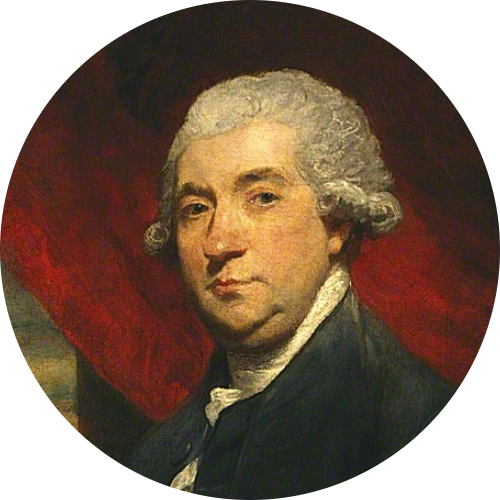
Lord Eglinton introduced the young James Boswell to the joys of London life during his 1760 stay in the city. After Boswell's arrival back in London in 1762, he wanted the Lord to use his influence with Prime Minister Bute to secure him a position in the Guards, and the Lord did deliver a letter from Boswell to Bute, but to no avail.
Although Boswell sometimes doubted the Lord's sincerity they remained good friends during Boswell's 1762-63 stay in the city, despite occasional misunderstandings.. Boswell often dined and slept at the Lord's house, especially during the spring of 1763, and he forgave the Lord for his flaws which (Boswell eventually thought) could not be helped.
On January 24, 1763, Boswell wrote about "the love which I cannot help having for this very agreeable nobleman". In his entry for January 25, 1763, he quoted one of the longest conversations in his journals, in which he talked with Lord Eglinton about their disagreements and their love for each other. At one point Boswell described "how my heart melted with tenderness, genuine candor, and joy".
On March 15, Boswell was informed by Eglinton's steward, that "My Lord desires you just to be one of the family." He spent that same evening with the Lord, discussing his [Boswell's] ambition to secure a position in the Guards. Boswell told Eglinton that he would accept no position but the Guards, to which Eglinton replied that he thought Boswell should "catch at any string." Boswell disagreed, arguing that "another commission would be a rope wherewith to hang myself; except you can get me one that is to be broke [disbanded], and then I am not forced from London."
Boswell was greatly saddened by the death of the Lord in 1769.
Seven years later, on March 15, 1777, Boswell visited Eglinton's mother, Susannah (née Kennedy), for the first time since his journey with Dr. Johnson in 1773. Boswell wrote about the visit, that
"[o]ne of my objects has been, for some time past, to write memoirs of my amiable and accomplished patron, the late Lord Eglinton; and in order to do this well, and illustrate my work, I was anxious to have his letters to his mother, a lady so distinguished. I asked her if she had them. She said yes. I expressed a fear that they might no be preserved. She said, "I'll give them to you."
Boswell visited again on March 17, and on this occasion, Lady Susannah allowed Boswell to
"let me search her cabinet in her presence and take all the letters that I chose. This was a great compliment. I was elevated by it. Yet my heart was touched with tender affection for my dear deceased Earl, to whose friendship I owed so much."
In the end, Boswell never succeeded in writing the Earl's biography, and the letters mentioned appears not to have survived to this day.