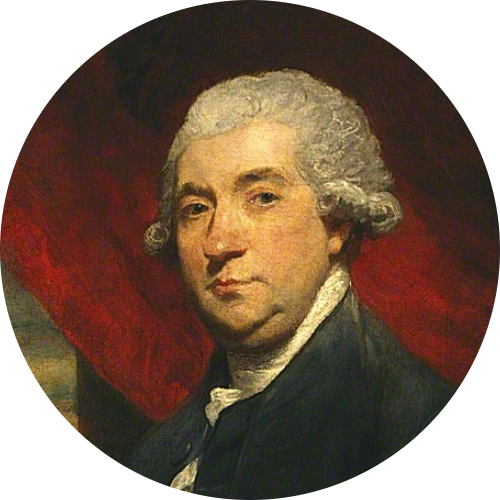

Actor-manager. Son of Colonel Thomas Digges of Chilham Castle, and Elizabeth West, daughter of the 6th Earl De La Warr. Quite the ladies' man, Digges in 1746 married Mary Wakeling and later had two common-law relationships with actresses Sarah Achurch Ward (from ca. 1752 until 1758) and George Anne Bellamy (from ca. 1761 and onwards), fathering up to six children.
Digges received his early education at Westminster School, London which he left in 1740. He became an ensign in Colonel James Long's Regiment of Foot (in January 1741) and later (in June 1744) in Colonel Richard O'Farrell's. He left the army in 1749 and shortly after began his acting career. His first stage appearance was in Venice Preserv'd at Thomas Sheridan's Theatre Royal in Dublin (1749). He continued to act, although with some breaks, in Dublin until 1756 when he moved to Edinburgh and became actor-manager of the Edinburgh Theatre (a.k.a. the Canongate Concert Hall). Often in debt and unpopular with his creditors, he moved around a lot for the remainder of his life, appearing at various times in Dublin, Edinburgh, London, Cork, Limerick, York and Liverpool.
He retired from acting in 1784, after having suffered a paralytic stroke during rehearsals for a new staging of Venice Preserv'd at Dublin's Theatre Royal - the same play and the same theatre in which he had had his theatrical debut 35 years before.
The first documented contact between Boswell and Digges is a letter from Digges dated April 9th, 1757 in which he thanked Boswell for sending him a prologue for a play. It is unclear for which play the prologue was meant, and no copy is known to exist today. Digges declined to use the prologue, apparently fearing that the prologue "may give offence to a Body of Persons" (unidentified). He wrote, however, that "[c]onsidering Your Age, and the short time you wrote the lines in, I think the Poetry very pleasing and deserving of Commendation. And I shall be glad of any opportunity of personally thanking You".1 The two probably met in person shortly thereafter and seem to have kept up a cordial friendship until at least Boswell's departure to Europe in 1763, where their correspondence virtually comes to a halt. However, there are records in Boswell's journals of the two meeting for social events until Christmas Eve, 1776.
West Digges was also one of the first persons mentioned in Boswell's London Journal. Boswell sat a while with him in Edinburgh on November 14, 1762, taking leave of him as one of the last before leaving for London on the next day. Boswell mailed The North Briton to Digges each week during his 1762-63 London stay. He also acquired various other kinds of literature for Digges (The plays Two Gentleman of Verona and The Citizen, among others.2
In his youth, and at least until 1763, Boswell admired many of Digges' social qualities and praised him in various journal entries. He was annoyed when James Love criticised Digges' acting.3
- 1"From West Digges, between 9 and 19 April 1757" in The General Correspondence of James Boswell, 1757-1763. The volume contains numerous other letters between the two, as well as a fairly detailed biography of Digges himself.
- 2 Correspondence of James Boswell and John Johnston, p. 62-3, n. 2
- 3 Boswell's London Journal, entry for December 14, 1762
A multi-page biography of Digges incl. some illustrations can be found in "A Biographical Dictionary of Actors, Volume 4, Corye to Dynion" (1975) by Highfill, et. al. It is available from AbeBooks.
In 1833 was published by Thomas Stevenson "Letters which passed between Mr. West Digges, comedian, and Mrs. Sarah Ward, 1752-1759". The volume was edited by James Maidment and William H. Logan and according to its introductory notice it contains "[o]riginal and curious information relative to dramatic affairs, especially in Edinburgh." It seems to have been printed in only 60 copies and is very difficult to come by today.
Comments
West Digges was my Great
Anonymous (not verified) Thu, 12/09/2010 - 11:26
West Digges was my Great GREAT GREAT GRANDFATHER PAULINE DIGGES JAMES
i am interested in finding
Anonymous (not verified) Mon, 06/27/2011 - 07:12
In reply to West Digges was my Great by Anonymous (not verified)
i am interested in finding out more about West Digges and possible descendents, particularly a West Digges who married Theodosia Yates in 1831.
West Digges and Sarah Ward
Anonymous (not verified) Wed, 12/07/2011 - 23:11
In reply to West Digges was my Great by Anonymous (not verified)
West Digges was the 'amour' of my six times Great Grandmother SARAH WARD, nee Hoare and together they had several children!
I am descended from her marriage to HENRY WARD and their son THOMAS ACHURCH WARD.
Thomas Achurch Ward was a Comedian/Actor and both his parents were Actors.
I am in the UK - where are you?
I would be delighted to hear from you.
Nicola
Digges
Ian Digges (not verified) Fri, 11/23/2018 - 12:39
In reply to West Digges was my Great by Anonymous (not verified)
Hello Pauline- Dudley Digges was my great uncle and Alec Digges was my father- we are probably related!